
Travel Guide
Sri Lanka
Colombo | Sigiriya & The Cultural Triangle | Kandy
Ella & The Hill Country | Yala | Mirissa & The South Coast
Temples · Tea · Safari · The Island That Has Everything

Welcome to Sri Lanka — The Island That Has Everything
Sri Lanka is one of the great comeback stories in modern travel. After decades of civil conflict, a tsunami, and a period of economic turbulence that temporarily deterred visitors, the island has emerged as one of the most rewarding destinations in Asia — a compact, dense, extraordinarily varied country that packs the cultural weight of India, the wildlife intensity of East Africa, the tea-plantation beauty of the Scottish Highlands, and the beach quality of the Maldives into an island roughly the size of Ireland.
The luxury proposition is singular. The Aman at Amanwella on the south coast — a 30-villa resort of extraordinary beauty — costs roughly 40% less than comparable Aman properties in Bali or Japan. Geoffrey Bawa, considered the father of tropical modernism and one of the most influential architects of the 20th century, built some of his finest work here, and many of those buildings are now operating as hotels: Heritance Kandalama, Jetwing Vil Uyana, the Ceylon Tea Trails. Sri Lanka is an island where architecture, landscape, culture, wildlife, and cuisine combine in a way that no single other destination in Asia quite manages.
This guide takes you from Colombo's architectural treasures through the ancient rock fortresses of the Cultural Triangle, the cool highlands of Kandy and Ella's tea estates, the leopard-dense wilderness of Yala National Park, and the whale-watching and beach culture of the south coast — a complete circuit of one of the world's most underrated islands.
Best Time to Visit
- December – March: The finest window for the south and west coasts (Mirissa, Colombo, Galle). Dry, warm, and clear. Best whale watching season (November–April, peak December–April). The Cultural Triangle and Hill Country are good year-round.
- April – May: The transition period — hot and dry in the north and east, the south coast beginning to cloud over. Yala is at its best April–June when water levels drop and leopards are most visible. Ella is beautiful.
- June – September: Southwest monsoon affects the south and west coasts — rain and rough seas. The east coast (Arugam Bay, Trincomalee) is dry and excellent. The Hill Country and Cultural Triangle are fine year-round.
- October – November: Short inter-monsoon rains affect most of the island briefly. November is the transition into the best season for the south.
- Sri Lanka's two monsoons mean the island is never entirely in bad weather — when the south is wet, the east is dry, and vice versa. A well-designed itinerary can visit the right coast at the right time.
- Yala National Park closes for six weeks annually (usually September) for wildlife management. Check dates before booking.
- The train from Kandy to Ella (considered one of the most scenic rail journeys in the world) books out weeks in advance for observation car seats — reserve at Kandy station the day before or book through your hotel.
- Blue whale watching off Mirissa peaks December–April. Book trips through established operators only — whale welfare standards vary significantly.
- Elephant gathering at Minneriya peaks August–October — one of the largest gatherings of Asian elephants in the world.
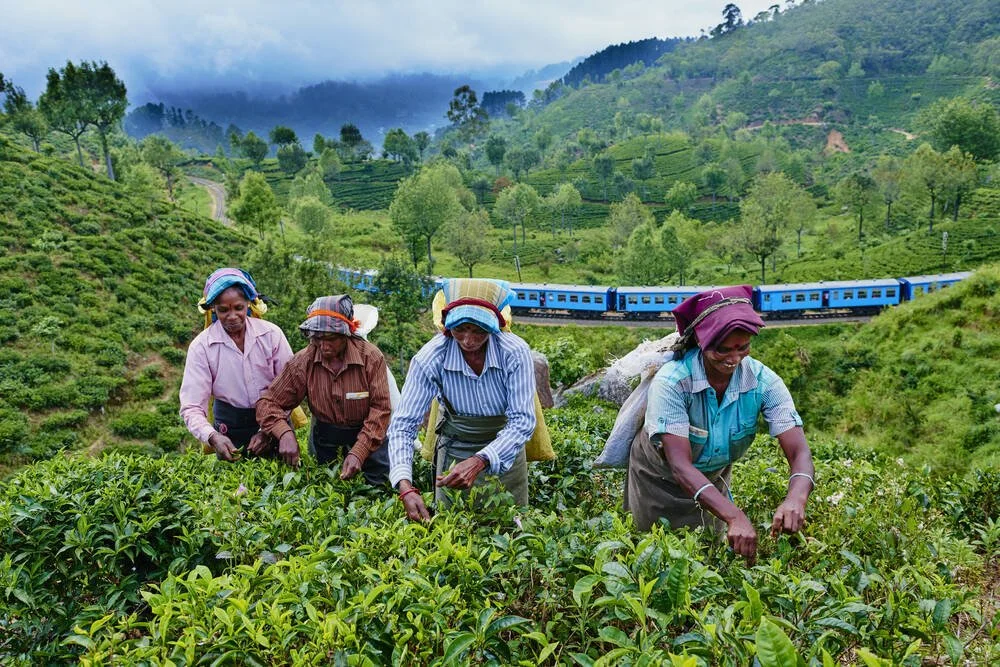
Sri Lanka in a single image: a tea picker on a hillside estate in the Hill Country, the landscape impossibly green behind her — the same scene that has repeated here every morning for 170 years
Sri Lankan Food — Spice, Rice & Coconut
Sri Lankan cuisine is one of the most underrated in Asia — fiery, fragrant, coconut-rich, and built on a spice tradition that goes back to the island's role as the epicentre of the Indian Ocean spice trade for two thousand years. Cinnamon, cardamom, pepper, cloves, and nutmeg are all native or long-cultivated here, and the cooking uses them with an assurance that comes from centuries of intimacy.
Must Try: Rice and curry (the national dish — not a single dish but a spread of six to eight small curries served with rice, each a different vegetable, protein, or condiment, eaten at lunch across the entire island), hoppers (bowl-shaped fermented rice flour pancakes, eaten for breakfast with a fried egg, sambal, and pol chutney — one of the great breakfasts in Asia), kottu roti (chopped flatbread stir-fried with vegetables, egg, and your choice of protein — the street food that defines Colombo nights), lamprais (a Dutch Burgher dish of rice and curry baked together in a banana leaf), and fresh king coconut (thambili) — the orange coconut specific to Sri Lanka, lighter and more fragrant than the green coconut, sold from roadside carts throughout the island.
The Capital Reborn — Geoffrey Bawa, Galle Face & the Finest Curry in the Indian Ocean

Galle Face Green, Colombo at dusk: the colonial-era esplanade facing the Indian Ocean, families flying kites, the sunset turning the sea gold — the city's great public living room and one of the finest sunsets in Asia
Geoffrey Bawa — Sri Lanka's Greatest Architect
Geoffrey Bawa (1919–2003) is considered the father of tropical modernism and one of the most influential architects of the 20th century — his work, rooted in the landscape and vernacular traditions of Sri Lanka, has been described as the direct ancestor of the luxury tropical resort aesthetic that now dominates hotel design across Southeast Asia and the Indian Ocean. In Colombo, his most accessible works include the Parliament of Sri Lanka (on a lake island outside the city — visible from the water and extraordinary), the Ena de Silva House (now the Barefoot Garden Café), and his own No. 11 Barnes Place (now the Colombo Geoffrey Bawa House, open for guided tours by appointment). The Lunuganga estate (2 hours from Colombo) is his masterwork — a country garden of extraordinary beauty that is now a small hotel.
Food
Ministry of Crab — in the old Dutch Hospital building in Fort — is the most famous restaurant in Sri Lanka, serving Lagoon Crab from the island's lagoon fisheries in preparations that range from Sri Lankan pepper crab to butter crab, at sizes that are measured in kilograms. Book at least one week in advance. Nuga Gama at the Cinnamon Grand is the finest rice and curry lunch in the city — a village-style restaurant in a hotel garden serving traditional Sri Lankan food from all regions. Monty's Lobby Bar at the Galle Face Hotel (opened 1864) for sundowner cocktails is a Colombo institution.
Experience Snapshot
Ancient Rock Fortress, Elephant Gatherings & 2,500 Years of Civilisation
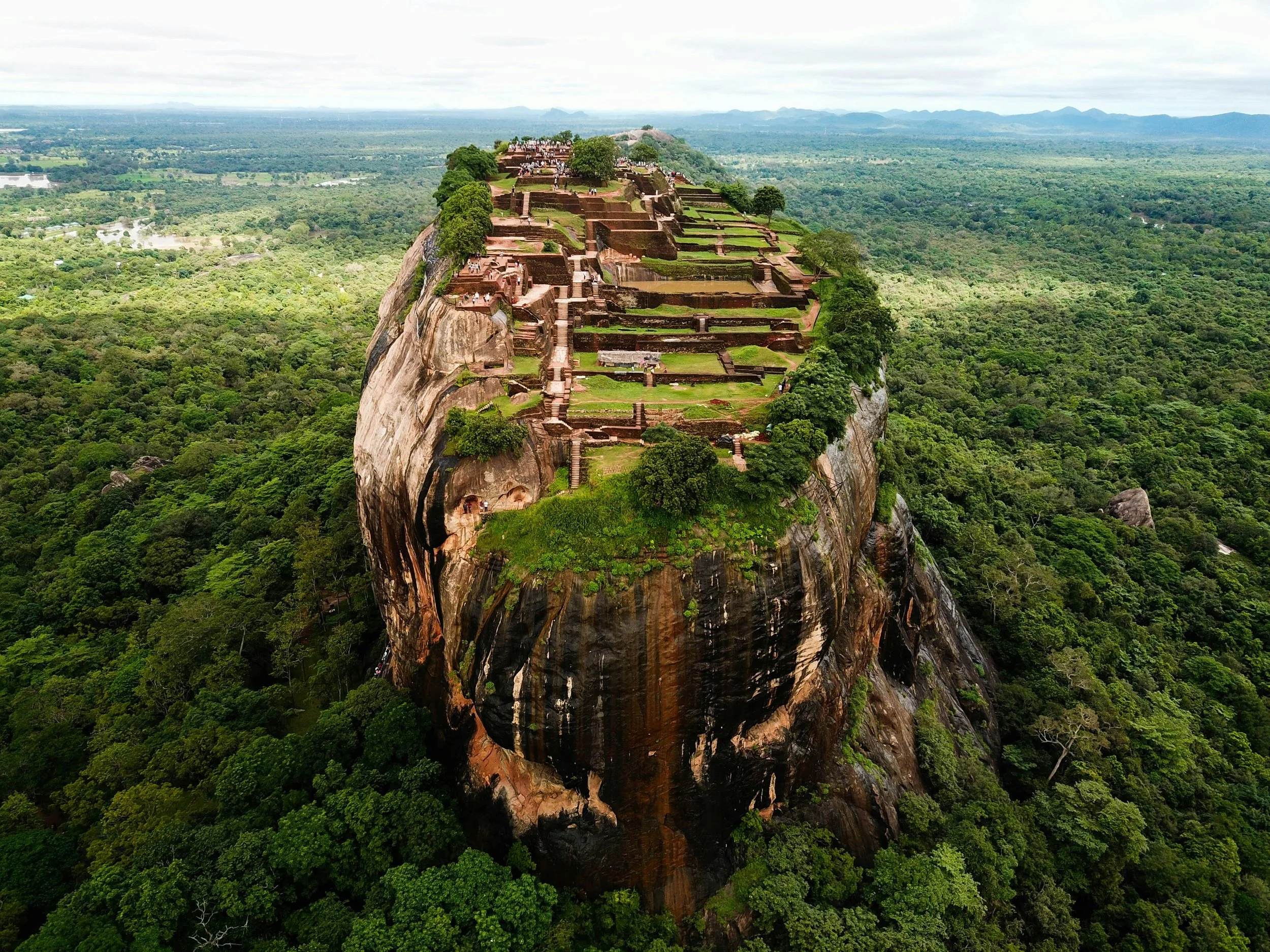
Sigiriya at dawn: a 200-metre volcanic rock rising sheer from the Sri Lankan jungle, its 5th-century fortress accessible via a staircase flanked by the world's oldest surviving secular frescoes — one of the great archaeological sites of Asia
Sigiriya Rock Fortress
Sigiriya is one of the great archaeological sites of Asia — a 200-metre volcanic rock rising sheer from the jungle, its flat summit bearing the remains of a 5th-century palace complex built by King Kasyapa as both fortress and pleasure garden. The ascent passes the world's oldest surviving secular frescoes (the "cloud maidens," painted on a cliff face around 480 AD), the famous Mirror Wall (a polished plaster surface so smooth that the king could see his reflection, now covered in ancient graffiti from visitors dating back to the 8th century), and the Lion Paws Gateway (where two enormous carved lion paws mark the final ascent). The summit view — jungle in all directions, the Dambulla Rock visible to the southwest, the plains of the north spreading to the horizon — is one of the finest in Asia. Climb at dawn, before the heat and the school groups arrive.
Dambulla Cave Temple & Polonnaruwa
Dambulla Cave Temple (15km from Sigiriya) — five cave temples containing 153 Buddha statues and 2,100 square metres of Buddhist murals, continuously active since the 1st century BC — is the largest cave temple complex in Asia and one of the finest Buddhist art sites in the world. Polonnaruwa (40km east) was the medieval capital of Sri Lanka from the 11th to 13th centuries — its ruins, spread across a vast park, include the Gal Vihara rock temple (four enormous Buddha figures carved from a single granite face), the Quadrangle complex, and the Parakrama Samudra reservoir. Best explored by bicycle (rentable at the park entrance) in the early morning.
The Minneriya Elephant Gathering — August to October
Every year from August through October, up to 300 Asian elephants converge on the Minneriya Tank (a 3rd-century man-made reservoir) as the surrounding jungle dries and the tank's grassy shores provide grazing. This is the largest known gathering of Asian elephants in the world — a natural phenomenon with no equivalent outside East Africa. The gathering is best viewed by jeep safari in the late afternoon when the elephants come to drink and bathe. Book through your hotel — the reputable operators enter the park in controlled groups and maintain distance from the herd.
Experience Snapshot
The Last Kingdom — Temple of the Tooth, Botanic Gardens & the Gateway to the Hills
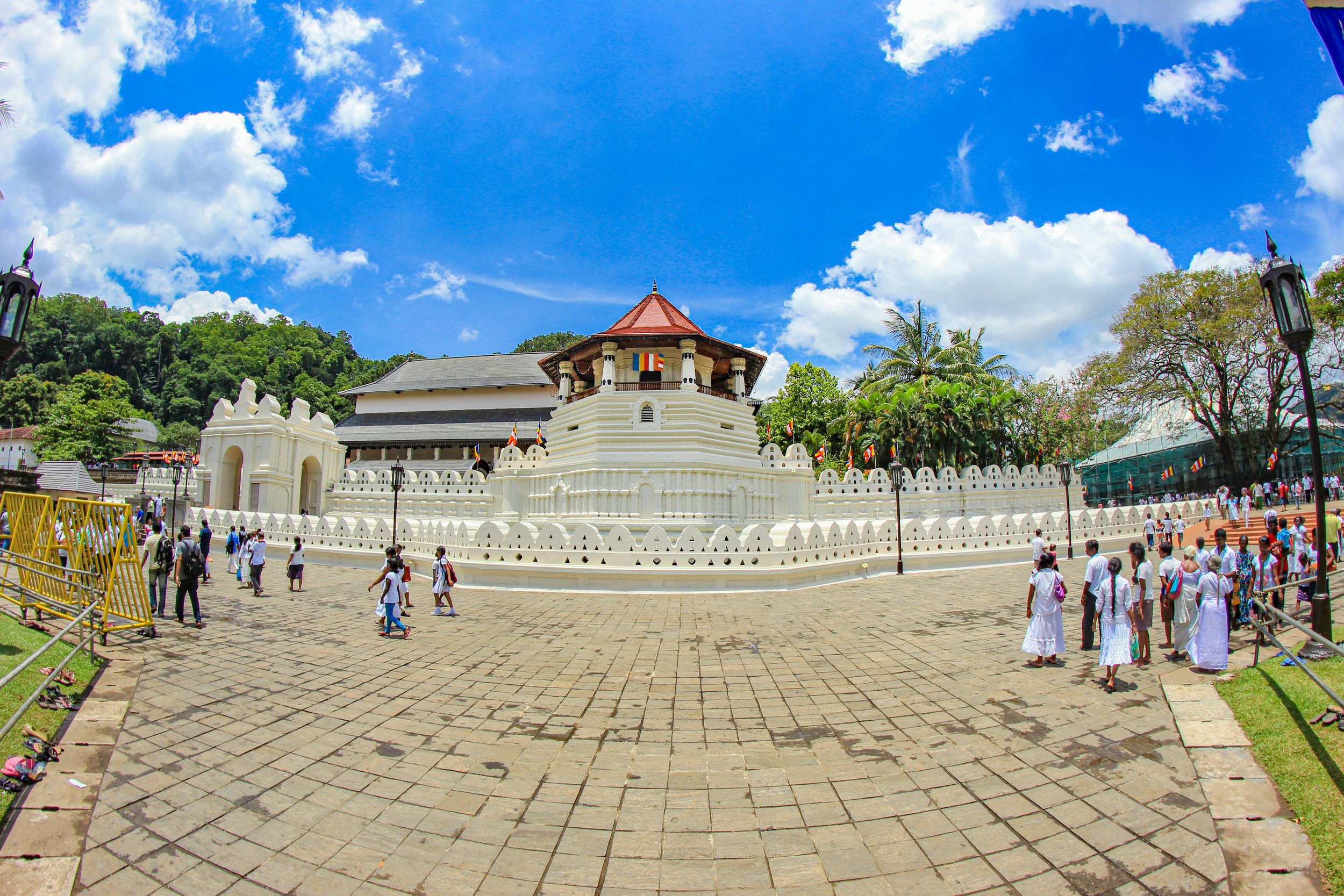
The Temple of the Tooth, Kandy at dusk: Sri Lanka's most sacred Buddhist site — housing a relic of the Buddha's tooth, brought to the island in the 4th century — reflected in the Kandy Lake at the moment the lamps are lit for evening puja
The Temple & The City
The Temple of the Tooth (Sri Dalada Maligawa) is Sri Lanka's most sacred site — the golden-roofed complex on the lake's northern shore houses a relic of the Buddha's tooth, brought to the island in the 4th century hidden in a princess's hair. Puja (offering ceremony) takes place three times daily (5:30am, 9:30am, 6:30pm) — attend the evening puja when the drums begin and the inner shrine is opened, clouds of incense rising in the lamplight. The Esala Perahera festival (July–August) is one of the great processions in Asia — ten days of elaborately costumed elephants, fire-dancers, and drummers parading through the streets of Kandy, culminating in a procession of over 100 elephants carrying the sacred tooth relic. Book accommodation a year in advance if your dates coincide.
The Royal Botanic Gardens at Peradeniya (5km from the city) are the finest botanic gardens in South Asia — 147 acres of orchids, spice gardens, an avenue of royal palms, a giant Javan fig tree that covers half an acre, and extraordinary views of the Mahaweli River. The Kandy Lake — built by the last Kandyan king in 1807 — is one of the most beautiful urban landscapes in Sri Lanka. Walk the circuit at dawn when the lake is still and the temple is lit for morning puja.
Experience Snapshot
Tea Estates, the Nine Arch Bridge & the Most Scenic Train Ride in Asia

The Nine Arch Bridge, Ella: a 1921 colonial-era viaduct of nine arches spanning the jungle gorge below Little Adam's Peak — most beautiful when a blue train crosses it in the early morning light
The Train Journey
The Kandy to Ella train — departing Kandy station at approximately 8:45am on the Badulla-bound service — is widely considered one of the most beautiful rail journeys in the world. The route climbs from Kandy at 500 metres through a series of tunnels and viaducts into the Central Highlands, passing tea estates draped across impossibly steep hillsides, waterfalls visible from the window, and small stations where vendors sell grilled corn and fresh coconut through the windows. The journey takes 6–7 hours to Ella. Book the observation car seats (1st class, open observation seats at the rear of the train) as early as possible — maximum two weeks in advance at Kandy station. Alternatively, sit by an open door in second class for the most cinematic experience.
Ella & Surroundings
Ella is a small town of one main street, several excellent guesthouses, and views across the Ella Gap to the plains below that extend to the horizon. The Nine Arch Bridge (1921, built entirely from stone and brick because steel was unavailable during World War I) is best photographed from the jungle path above it when a train crosses — typically the 9:15am service. Little Adam's Peak is a 2-hour return hike through tea estates with extraordinary highland views — suitable for most fitness levels, best at dawn. Ravana Falls (6km from town) is one of the widest waterfalls in Sri Lanka and swimmable in the dry season. The Ceylon Tea Trails — a collection of colonial-era tea estate bungalows operated as a luxury hotel — is one of the finest accommodation experiences in Sri Lanka, offering private butler service in a restored 1920s planter's bungalow surrounded entirely by working tea estates.
Experience Snapshot
The Highest Density of Leopards in the World — Sri Lanka's Wild South
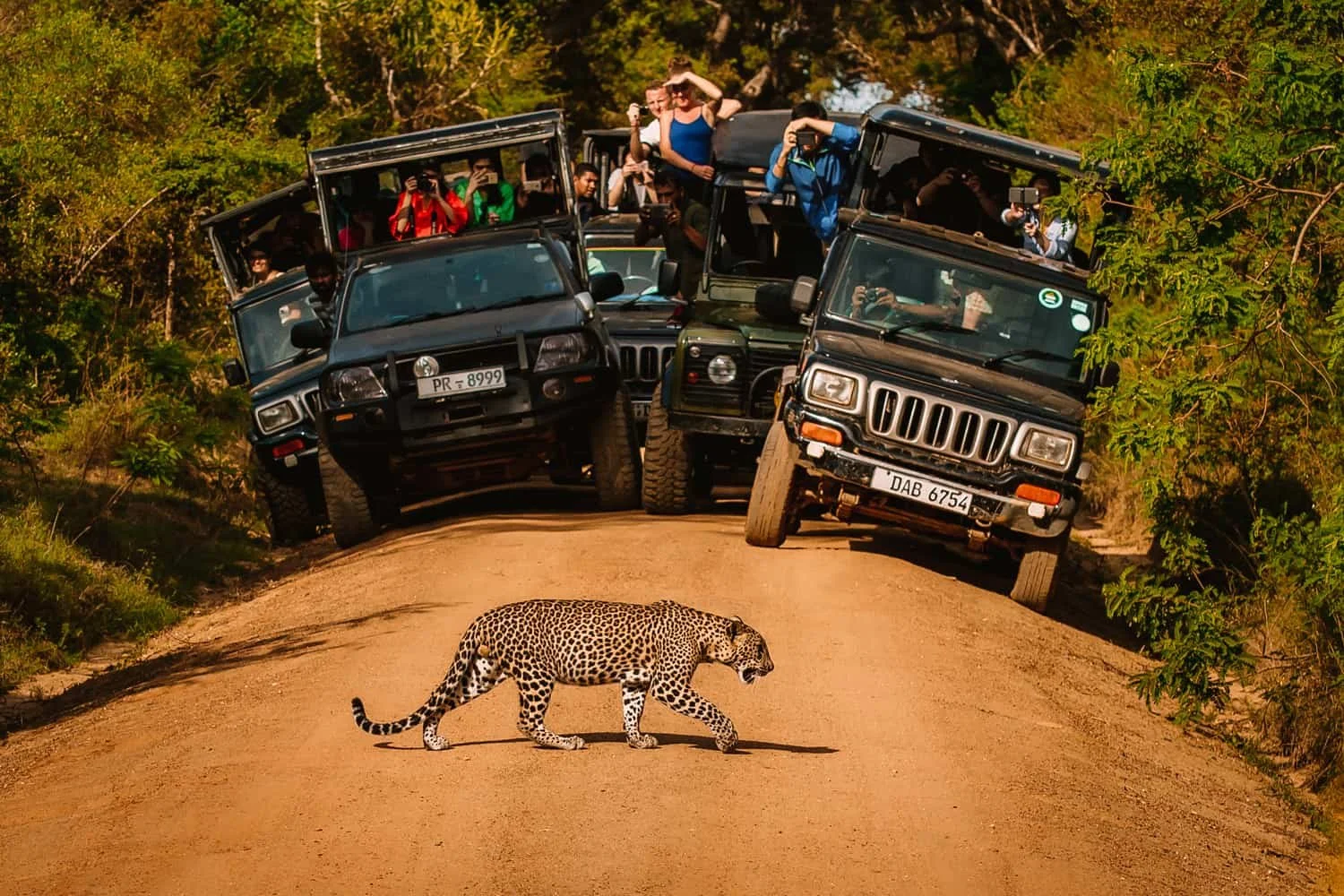
A leopard in Yala at golden hour: Sri Lanka's premier wildlife destination has the highest recorded density of leopards of any national park in the world — you are more likely to see a leopard here than anywhere else on earth
The Park & Wildlife
Yala is divided into five blocks — Block 1 is the most visited and has the highest leopard density; Blocks 2 and 3 are less visited and better for elephant sightings. The Sri Lankan leopard (Panthera pardus kotiya) — a subspecies found only on the island — is the apex predator and the main draw. Yala's leopards are extraordinarily visible because the terrain (open scrubland, rocky outcrops, lagoons) gives them fewer places to hide than African savannah, and because the population has not been hunted for generations.
Other regular sightings include Asian elephants (herds of 20–30 are common near the park's lagoons), sloth bears (most active in the morning and evening, extremely distinctive), mugger crocodiles (enormous — up to 5 metres, basking at lagoon edges), and painted storks, flamingos, and sea eagles at the coastal lagoons. The best game drives are dawn (5:30–9am) and late afternoon (3–6pm) — both aligned with leopard activity peaks.
Experience Snapshot
Blue Whales, Surf Breaks & the Most Beautiful Coast in Sri Lanka
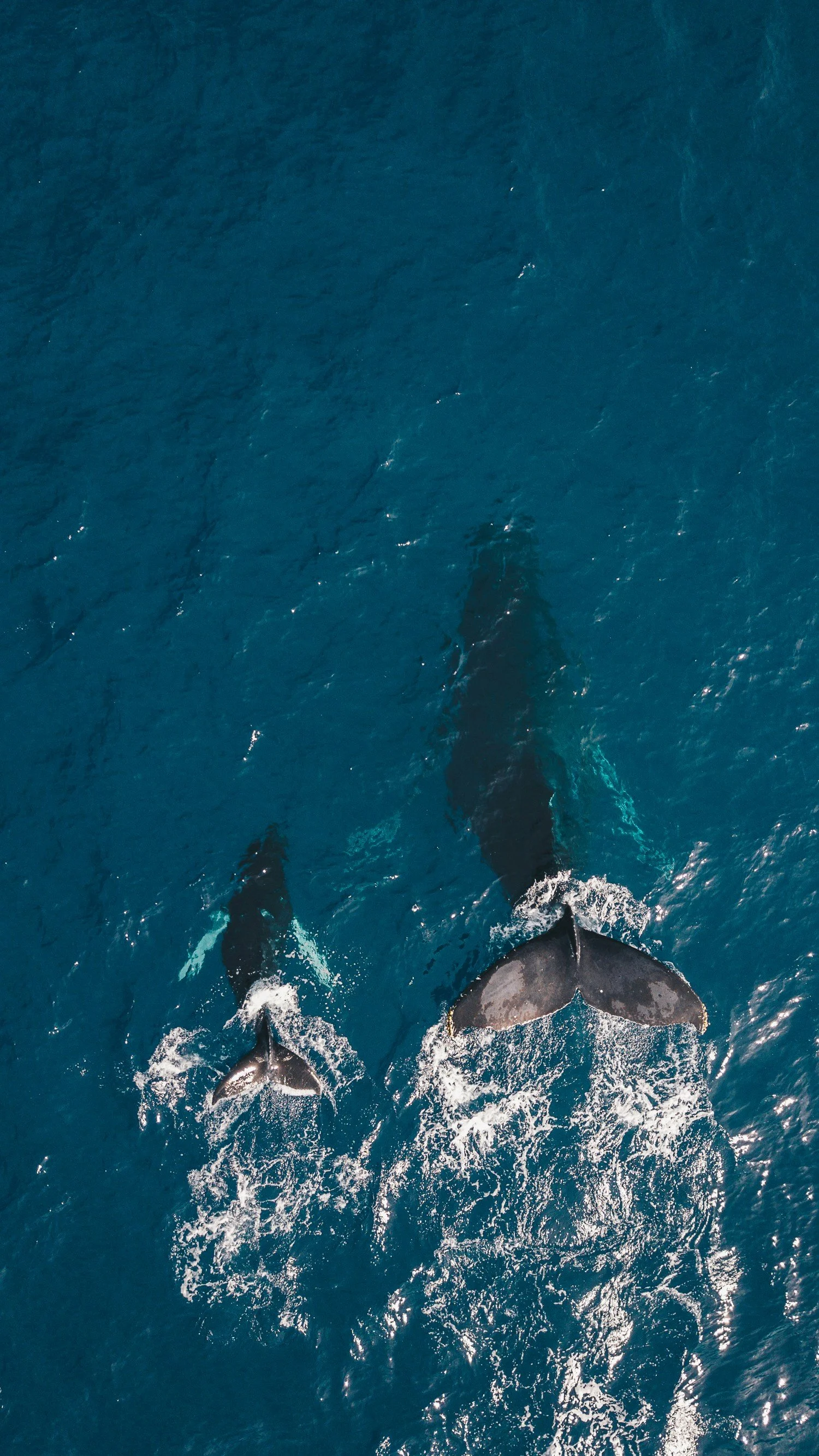
A blue whale off Mirissa: the largest animal that has ever lived on earth, surfacing 10 kilometres off the Sri Lankan coast on a December morning — the most extraordinary wildlife encounter available in Asia
Mirissa & Whale Watching
Mirissa is a crescent beach town on the south coast, approximately 150km from Colombo — small enough to walk end-to-end in 20 minutes, with a string of beach restaurants, surf hire shops, and the departure point for the finest whale-watching experience in Asia. The deep water trench off Mirissa — the Sri Lanka Trench, one of the deepest in the Indian Ocean — concentrates blue whales (the largest animals that have ever lived on earth) close to shore from November through April. Sperm whales, Bryde's whales, and spinner dolphins are regular sightings. The best operators leave at 6am and return by 11am — choose operators affiliated with the Sri Lanka Whale and Dolphin Trust, which enforces responsible approach distances and engine-off viewing.
Galle Fort
Galle Fort — a Dutch colonial fortified town built in 1663 on a promontory of the southern coast — is the finest example of a European colonial fort in Asia and a UNESCO World Heritage Site. The fort walls are perfectly preserved; the interior is a living town of Dutch-era churches, mosques, colonial warehouses converted into boutique hotels and restaurants, and winding streets where ox carts still pass between luxury design shops. The Fort Bazaar (a converted Dutch warehouse, now one of Sri Lanka's finest boutique hotels) and Amangalla (the Aman property in the former Dutch East India Company's guest house, in continuous operation since 1684) are the two finest addresses inside the fort. Walk the ramparts at sunset — the view of the Indian Ocean breaking against the walls is one of the most beautiful in Sri Lanka.
Experience Snapshot

Sri Lanka is best explored by a combination of train (Kandy to Ella — unmissable), tuk-tuk (for local movement in any town), and a private driver-guide (essential for the Cultural Triangle and south coast circuit)
Getting Around
International Entry: Bandaranaike International Airport (Colombo) is the main entry point. A new international airport at Mattala (near Hambantota in the south) has limited services. Most nationalities require an Electronic Travel Authorization (ETA) before arrival — apply at eta.gov.lk (approximately $35 USD, valid 30 days).
The Train: The Kandy to Ella train is the single most important transport experience in Sri Lanka — book observation car seats at Kandy station a day in advance. The Colombo to Kandy train (2.5 hours) and the Colombo to Galle train (2.5 hours along the coast) are both excellent scenic journeys. Sri Lanka Railways booking: rajadhani.cse.mrt.ac.lk
Private Driver-Guide: For the Cultural Triangle, the south coast circuit, and Yala, a private driver-guide is the most efficient and rewarding way to travel — one person who knows the roads, the history, and the best rice and curry restaurants. Rates are approximately $50–80 USD per day including vehicle. Your hotel can arrange a reliable driver; alternatively, Lakpura, Jetwing Travels, and Aitken Spence Travel are the most reliable DMCs on the island.
Tuk-tuks: For local movement within any town — negotiate the price before you get in. Grab operates in Colombo. Outside Colombo, negotiate directly.
Visas, Currency & Money
The Electronic Travel Authorization (ETA) costs approximately $35 USD and can be obtained at eta.gov.lk before departure — apply at least 48 hours before arrival. The Sri Lankan Rupee (LKR) is the currency. USD is widely accepted at hotels. ATMs are available in all cities and tourist areas. Credit cards are accepted at hotels and major restaurants. Sri Lanka is extremely good value — a five-star hotel in Colombo or Galle costs approximately 40–60% less than an equivalent property in Bali or Thailand.
Health & Safety
Vaccinations: Hepatitis A and B, typhoid, and tetanus are standard recommendations. Rabies vaccination is recommended for wildlife-focused itineraries (Yala). Consult your physician at least 6 weeks before departure. Water: Bottled water only throughout Sri Lanka. Mosquitoes: Dengue is present — use DEET repellent at dawn and dusk. Malaria risk is very low in tourist areas but discuss with your doctor for extended rural travel. Sun: The Sri Lankan sun at altitude (Hill Country) is deceptive — carry sunscreen and stay hydrated. At sea level, the combination of humidity and UV is intense.
Sri Lanka is the island that has everything.
Ancient rock fortresses rising from the jungle. Tea estates draped across impossible hillsides.
A blue whale surfacing ten kilometres offshore. A leopard on a rock at golden hour.
And all of it at a price that makes you feel like you've found something the world hasn't finished discovering yet.