
Travel Guide
Ghana
Accra | The Gold Coast | Kumasi
Tamale & the North
Food · Culture · Heritage · Where to Stay, Eat & Explore

Welcome to Ghana
Ghana is West Africa's most welcoming gateway — and one of the continent's most rewarding travel destinations. It was the first sub-Saharan African country to gain independence from colonial rule, and that pride runs through every interaction, every market, every festival. Ghanaians call their country the Gateway to Africa, and the name is apt: this is a place where the continent's extraordinary culture, history, and warmth are accessible, safe, and deeply moving.
This guide takes you through four distinct Ghanas: the vibrant, rapidly evolving capital of Accra; the haunting historical weight of the Gold Coast and its slave castles; the Ashanti cultural heartland of Kumasi; and the ancient, spiritual landscapes of Tamale and the north. Together they form one of the most complete and unforgettable journeys in Africa.
Best Time to Visit
- November – March: The dry season — the best overall window for travel. Cooler temperatures, clear skies, and the harmattan wind (a dry dusty breeze from the Sahara) from December onwards. Ideal for the north and the coast.
- April – June: The long rainy season begins. Green, lush, and dramatic — the forest regions are extraordinary. Heat and humidity are high on the coast.
- July – August: Brief dry spell in the south. A good shoulder season with fewer visitors.
- September – October: Short rains return. Roads in the north can become challenging. The coast remains manageable.
- Ghana is relatively close to the equator — it is warm year-round (25–35°C). Pack light, breathable clothing for all seasons.
- The harmattan (Dec–Feb) brings haze and dust — photography can be tricky but the cool, dry air makes travel comfortable.
- The Homowo festival (Accra, August–September) and Akwasidae (Kumasi, every six weeks) are extraordinary cultural events — time your visit if possible.
- Malaria prophylaxis is strongly recommended regardless of season — consult your doctor before departure.
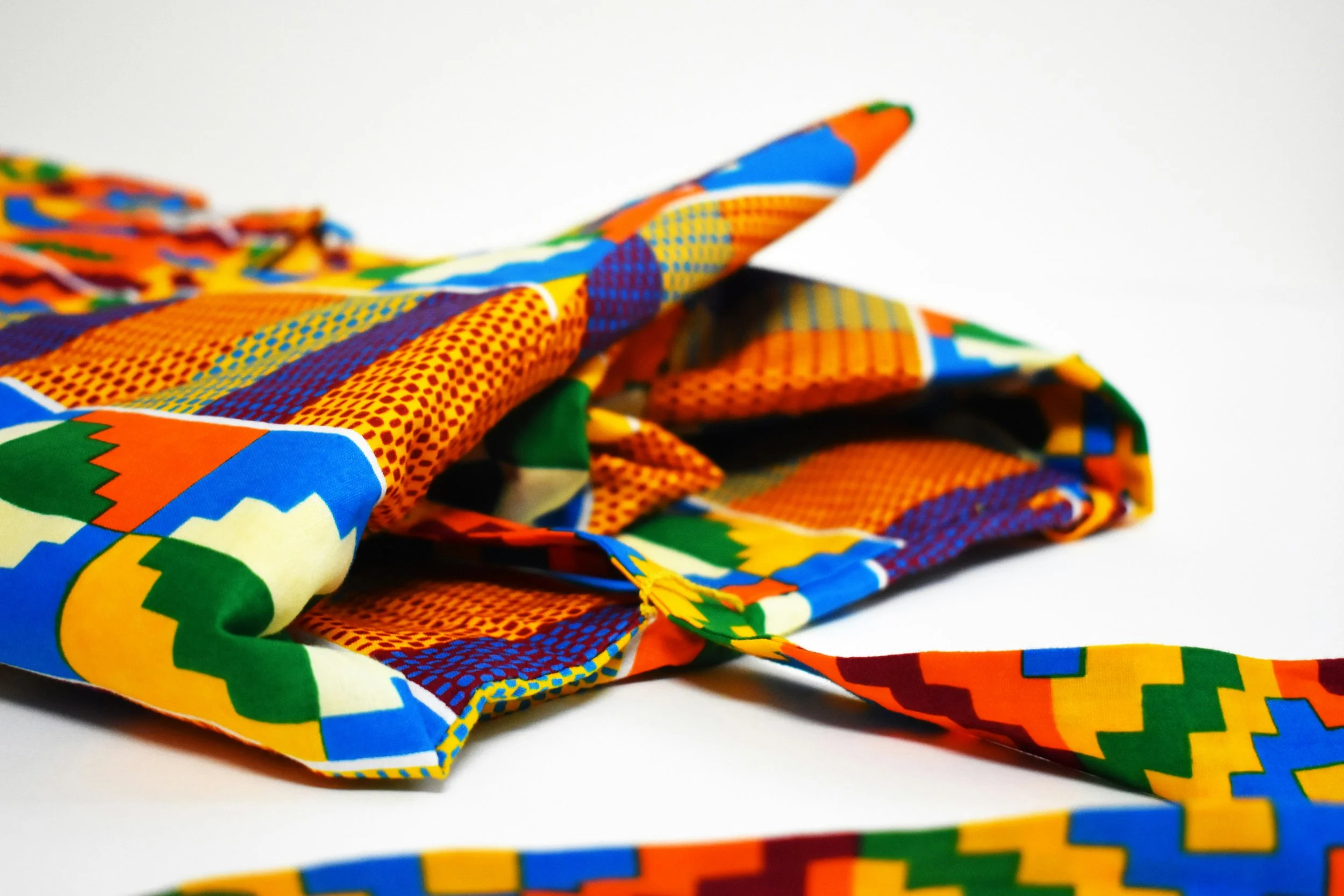
Kente cloth — woven on traditional strip-looms in the Ashanti region — is one of the world's great textile traditions, its geometric patterns carrying layers of cultural meaning
Culture & Character
Ghana's culture is layered with remarkable depth. The Akan peoples of the south — including the Ashanti, the largest and most historically powerful group — have one of Africa's most developed royal traditions, expressed through golden regalia, elaborate court ceremonies, and the living institution of the Asantehene (the Ashanti king) in Kumasi. The north is home to diverse groups including the Dagomba, whose ancient traditions of music, craft, and Islam predate European contact by centuries.
Throughout the country, Ghanaians are renowned for their warmth and directness. The greeting culture is important — take time with it. Akwaaba (welcome) is the word you will hear most, and it is meant.
Food & Drink — What to Know
Ghanaian food is built on bold flavours and communal sharing. Jollof rice (the intensely debated West African rice dish — Ghana's version is excellent, smoky, and richly spiced), fufu (pounded cassava and plantain served with soup — eaten by hand, a cultural ritual in itself), kelewele (spiced fried plantain, the perfect street snack), waakye (rice and beans cooked together, sold at street stalls from dawn), and banku with tilapia (fermented corn dough with whole grilled fish and pepper sauce) are the essential starting points. Fresh coconut water, sobolo (hibiscus drink), and Club beer are the drinks to know.
Africa's Most Vibrant Capital — Creative, Proud & Rapidly Becoming
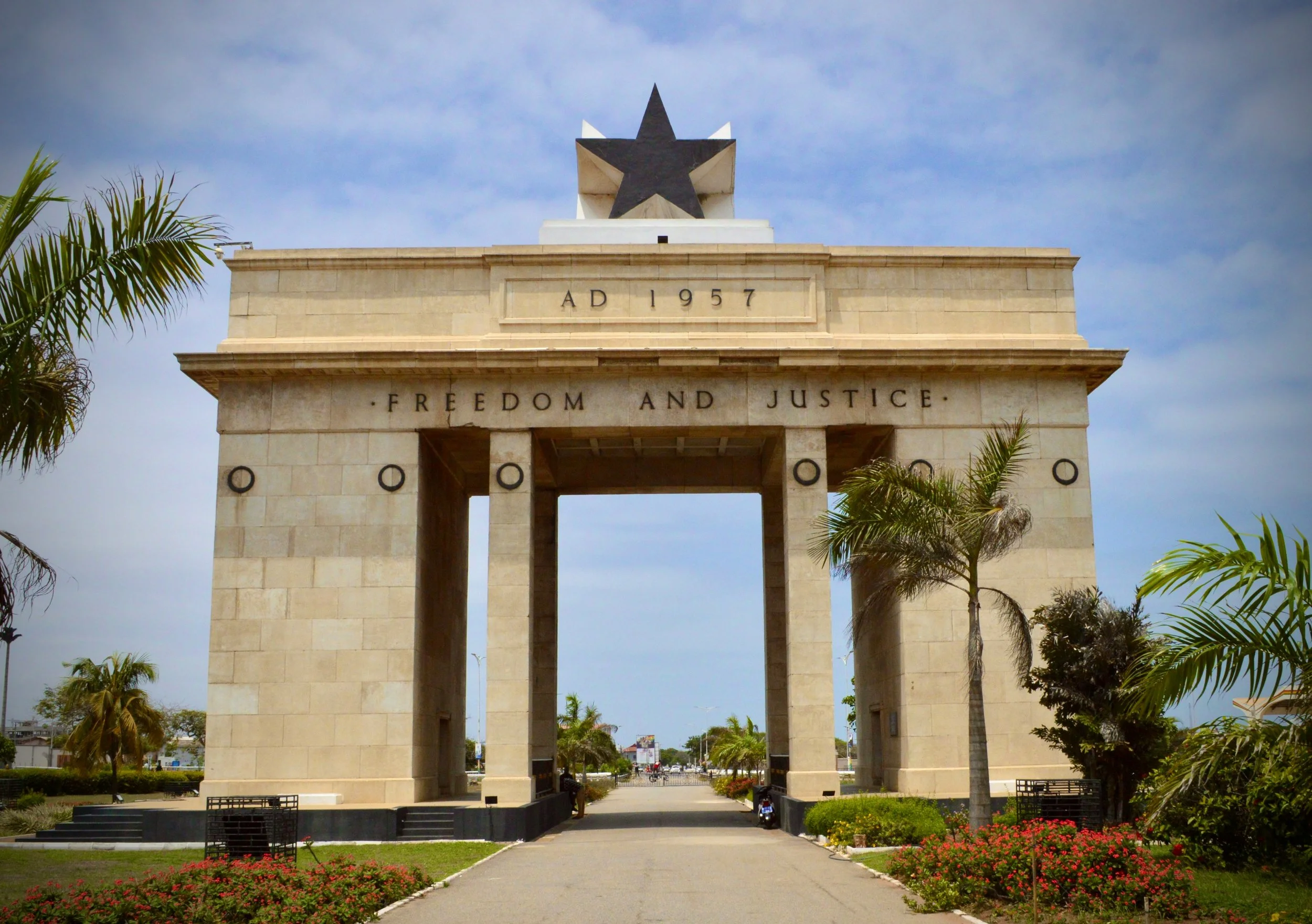
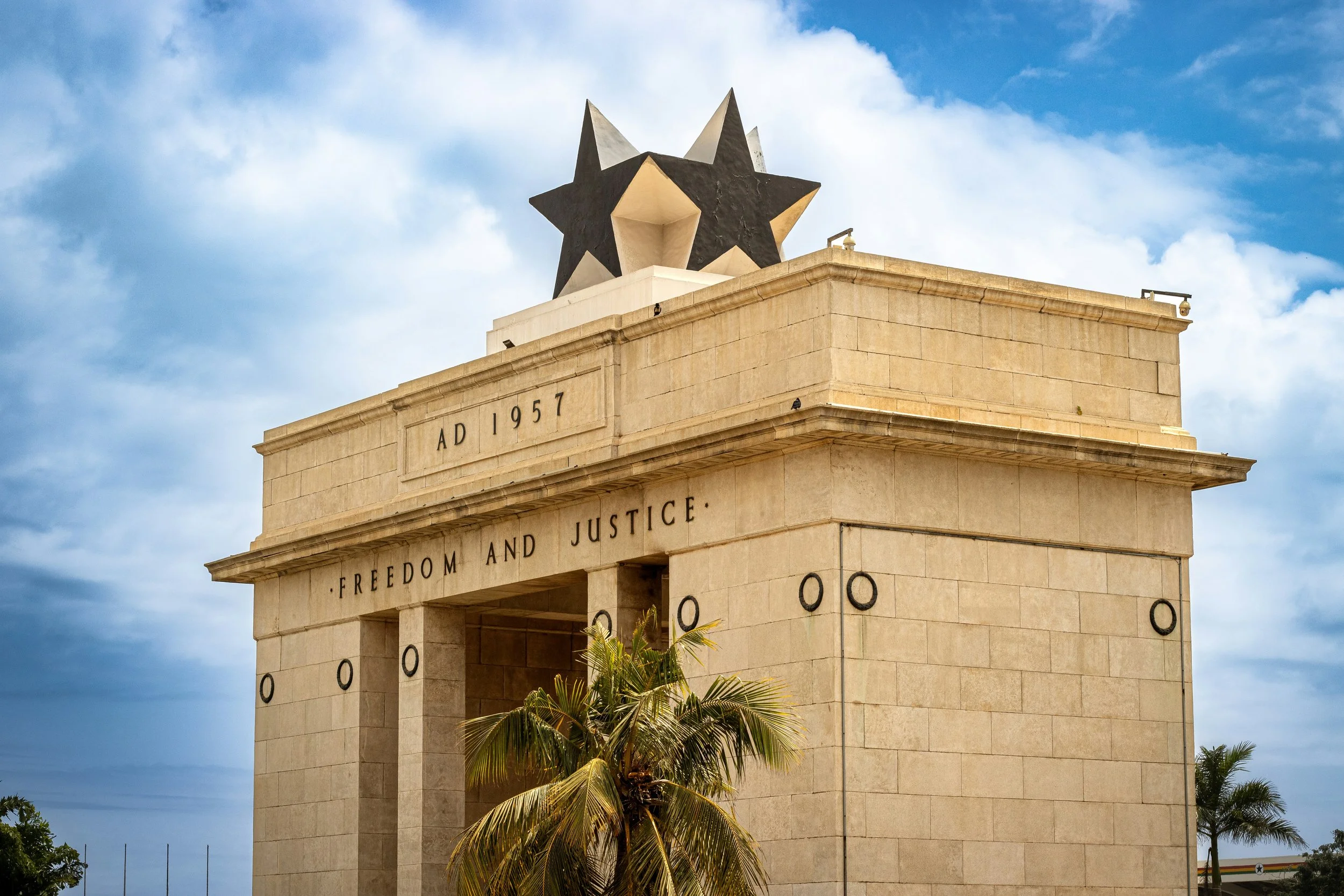
The Black Star Gate in Independence Square: Ghana's independence monument, where Kwame Nkrumah declared freedom from British rule on 6th March 1957
Culture & Vibes
Accra is one of Africa's great capital cities — and one of the most underrated on the continent. The city sprawls from the Atlantic coast inland across a series of neighbourhoods each with its own distinct character: the colonial streets and colourful fishing boats of Jamestown, the galleries and restaurants of Osu and Labone, the luxury hotels and diplomatic compounds of Airport Residential, and the extraordinary energy of Makola Market, where the entire city seems to converge in a roar of colour, noise, and commerce.
Since independence in 1957, Accra has been the cultural engine of West Africa. Today it is home to a thriving contemporary art scene — the Nubuke Foundation, Gallery 1957, and the National Museum are essential stops. The music scene (Afrobeats, highlife, hiplife) pulses through the city every evening. And the Year of Return in 2019 — Ghana's government invitation to the African diaspora — has brought a new wave of energy, investment, and cultural pride to the capital.
Food
Street food: Accra's street food is among the best in West Africa. Waakye stalls open at dawn on every major street — arrive early, the best is gone by 9am. Kelewele vendors set up at dusk in Osu and Labone. The night markets around Circle and Kaneshie serve banku, fufu, and grilled tilapia until midnight.
Restaurants: Buka Restaurant in Osu serves elevated West African cuisine in a beautiful open-air space. Bistro 22 is Accra's most refined dining experience. Labadi Beach Hotel Sunday brunch is an Accra institution. For the full local experience, Auntie Muni Waakye at Osu is legendary — arrive by 7am.
Experience Snapshot
Elmina & Cape Coast — Where History Demands to Be Felt
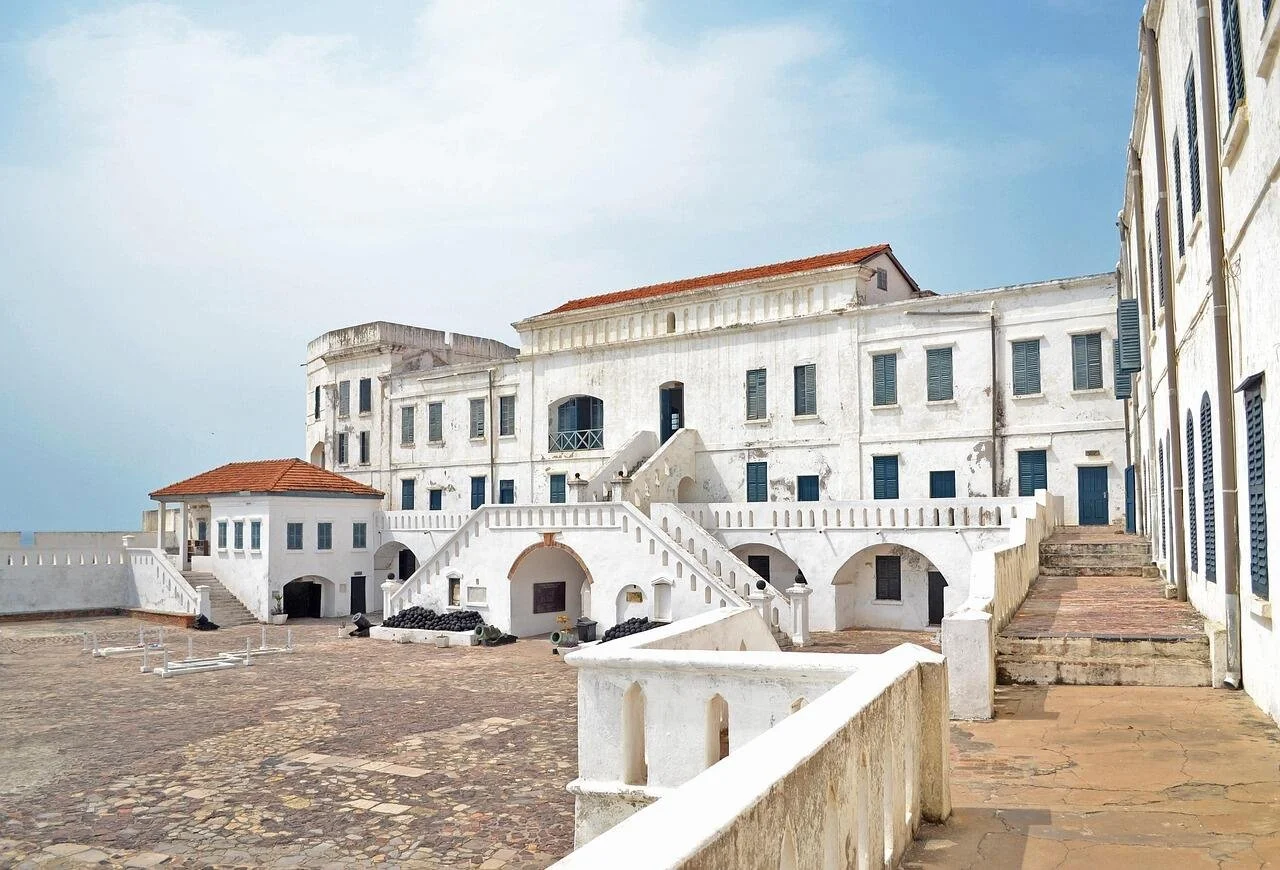
Elmina Castle: built by the Portuguese in 1482, it is the oldest European building in sub-Saharan Africa — and the site of unimaginable human suffering during the transatlantic slave trade
The Heritage — Understanding the Castles
Context: The Transatlantic Slave Trade on the Gold Coast
Between the 15th and 19th centuries, the coastline of present-day Ghana was the site of one of history's most catastrophic crimes against humanity. Over three hundred years, European powers — first the Portuguese, then the Dutch, the British, and others — built a chain of forts and castles along this coast to facilitate the capture, holding, and shipment of enslaved Africans to the Americas and the Caribbean. Estimates suggest that between 10 and 12 million Africans were transported across the Atlantic, with many more dying during capture or imprisonment. A significant proportion of the African diaspora in the United States, the Caribbean, and Brazil can trace their ancestry to this exact coastline.
The two most important sites are Elmina Castle (built by the Portuguese in 1482 — the oldest European structure in sub-Saharan Africa) and Cape Coast Castle (held successively by the Swedes, the Danes, and the British, and for centuries the main departure point for enslaved people to the Americas). Both are UNESCO World Heritage Sites. Both offer guided tours led by Ghanaian historians whose own families carry the memory of what happened here. The tours last approximately 90 minutes and include the dungeons, the "Door of No Return," and the governor's quarters above — the proximity of luxury to suffering is among the most disturbing elements of the site.
Visiting these castles is not comfortable. It is not meant to be. It is an act of bearing witness — an important, necessary, and ultimately deeply human experience. The Ghanaian government and local communities have deliberately kept these sites intact rather than softened them, precisely because the discomfort is the point. Come prepared, come respectfully, and give yourself time afterwards.
Elmina
Elmina is a working fishing town of great beauty — the colourful wooden pirogues (fishing boats) hauled up on the beach each morning, the narrow colonial streets, the twin castles overlooking the lagoon and sea. Beyond the castle, the town itself rewards wandering: the Dutch cemetery, St. George's Church (Ghana's oldest), and the lively fish market on the beach where the day's catch is smoked, traded, and sold in extraordinary organised chaos. Allow a full day for Elmina — half for the castle, half for the town.
Cape Coast
Cape Coast Castle is larger and in some ways more affecting than Elmina — the scale of the male and female dungeons, the Door of No Return, and the extraordinarily well-preserved governor's residence above are all part of the same immersive, guided experience. Cape Coast town is livelier and more developed than Elmina, with good restaurants and accommodation options. The nearby Kakum National Park offers one of West Africa's great natural experiences: a canopy walkway suspended 30 metres above the rainforest floor, stretching through the forest canopy.
Experience Snapshot
The Ashanti Capital — Gold, Kente & the Soul of a Kingdom

Kumasi's Kejetia Market — one of the largest open-air markets in West Africa, where Kente cloth, gold jewellery, herbal medicine, and everything else on earth is bought and sold daily
Culture & Vibes
Kumasi is the capital of the Ashanti Region and the seat of the Ashanti Empire — one of the most powerful and sophisticated kingdoms in African history. The Asantehene, the Ashanti king, still holds genuine cultural and political authority, and the Manhyia Palace remains the centre of a living royal tradition that includes elaborate durbar ceremonies, the Golden Stool (the sacred throne that embodies the soul of the Ashanti people), and a complex system of festivals that draws Ashantis from across the world.
The city itself is busy, dense, and commercially vibrant. The recently renovated Kejetia Market — one of the largest markets in West Africa — is an overwhelming, extraordinary experience: thousands of stalls selling Kente cloth, gold jewellery, yams, herbal medicines, electronics, and livestock across a vast complex that operates from dawn to dusk. A local guide here is invaluable.
Kente & Craft
The village of Bonwire, 20 minutes from Kumasi, is the spiritual home of Kente weaving. Watch master weavers work narrow strip-looms on their front porches — the geometric patterns produced are not decorative but communicative, each design carrying specific meanings tied to Ashanti history, proverbs, and values. Kente purchased directly from weavers in Bonwire is significantly better quality and more fairly priced than market reproductions. The village of Ntonso specialises in Adinkra cloth printing — hand-stamped with symbolic motifs using natural dyes.
Food
Kumasi is known for particularly good fufu — served with light soup, groundnut (peanut) soup, or palm nut soup, always eaten communally and by hand. Nkyinkyim Restaurant is the best restaurant in the city for elevated Ghanaian cuisine. The Kumasi Central Market food section is exceptional for local dishes. For something lighter, the hotels around Ahodwo serve good continental options.
Experience Snapshot
The Ancient Savannah — Mud Mosques, Wildlife & a Slower Ghana
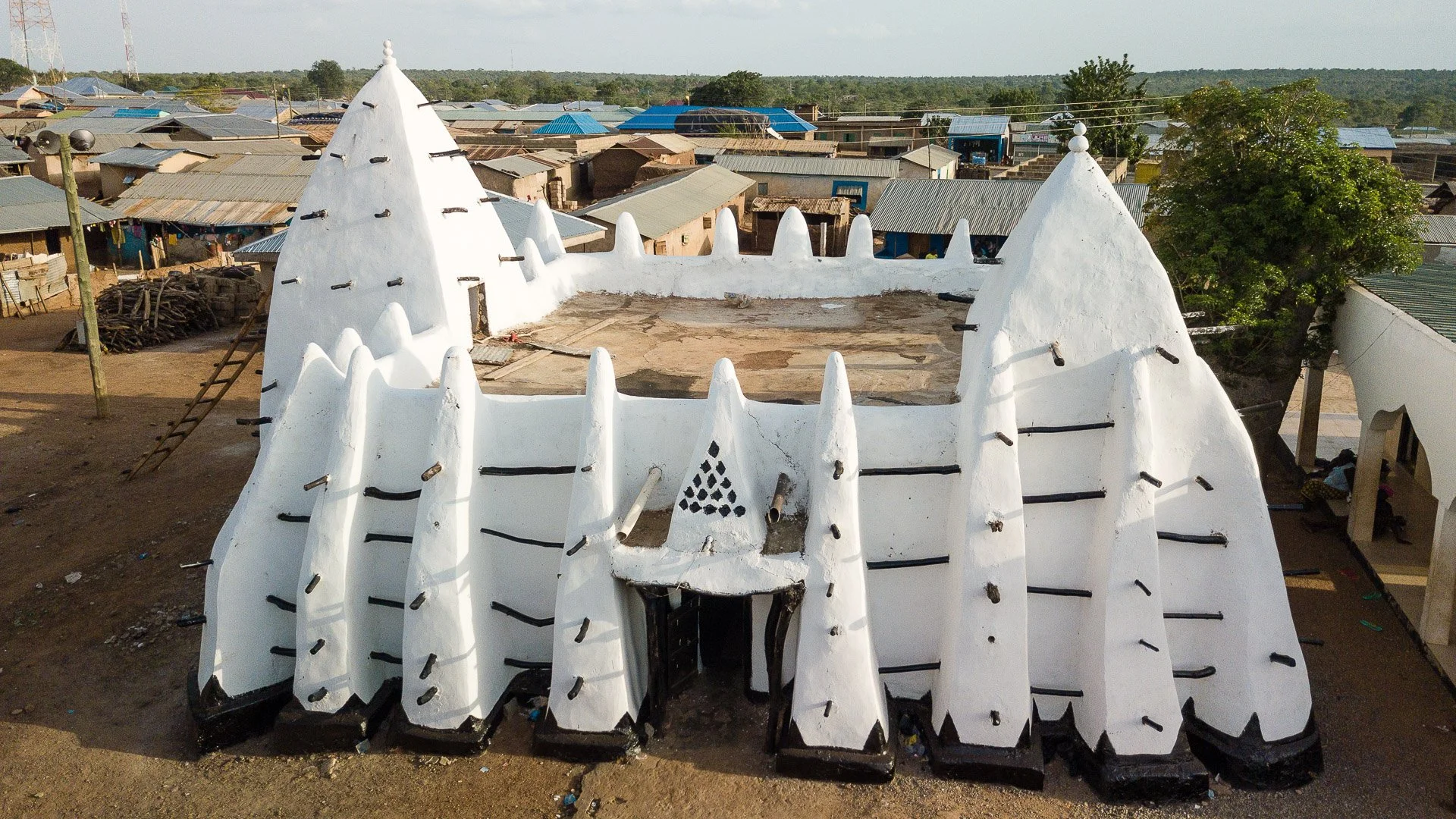
The mosque of Larabanga: one of the oldest mosques in West Africa, built in the Sudano-Sahelian style of mud and timber — and still an active place of worship for the surrounding community
Culture & Vibes
Northern Ghana is a revelation for visitors expecting the tropical south. The landscape shifts to open savannah, guinea corn fields, and villages of traditional round mud-brick compounds with thatched roofs. The dominant religion is Islam, practised alongside traditional customs in a remarkable syncretic blend. The Dagomba people — the largest ethnic group in the north — have a sophisticated royal system, a rich tradition of court music (the lunsi praise drummers), and festivals of extraordinary visual splendour.
Tamale is the capital of the Northern Region and Ghana's third-largest city — growing fast, with a friendly, distinctly less pressured atmosphere than Accra. It is the base for day trips to the remarkable mud mosque of Larabanga (one of the oldest mosques in West Africa, dating to the 15th century), to Mole National Park, and to the traditional palace compounds of surrounding villages.
Mole National Park
Ghana's largest national park, located 1.5 hours west of Tamale, is one of West Africa's finest wildlife destinations. The park protects 93 mammal species including large herds of elephant (often seen at the waterhole directly below the Mole Motel), buffalo, warthog, green monkey, colobus monkey, kob antelope, and over 300 bird species. Unlike East African safari parks, Mole offers something extraordinary: walking safaris with armed rangers — the chance to approach elephants and other wildlife on foot is an experience unavailable in most of Africa's famous parks.
Mole National Park — Planning Your Visit
Getting there: 1.5-hour drive from Tamale (hire a car and driver — public transport exists but is slow). The road is sealed most of the way. Accommodation: The Mole Motel is the park's main accommodation, built on a cliff above the waterhole — elephants and warthogs are often visible from the restaurant terrace at any time of day. Book ahead during high season (Nov–Feb). Best time: November to March for wildlife concentration around waterholes. Walking safaris: Depart twice daily (6am and 3:30pm) with armed rangers. Cost is very modest. Early morning is best for elephant sightings. Entry fees to the park are payable at the gate and are essential — they directly fund conservation.
Food & Craft
Northern Ghanaian food is distinct from the south — heavier on millet, guinea corn (sorghum), and shea butter. TZ (tuZaafi — fermented millet porridge) with ayoyo leaf soup is the northern staple. Smoked guinea fowl is the north's signature protein, sold grilled on roadside stalls. The craft tradition of the north is extraordinary: Bolgatanga baskets (woven from elephant grass in vivid geometric patterns) are some of West Africa's finest crafts and available throughout Tamale market.
Experience Snapshot

Ghana is West Africa's most accessible destination — safe, welcoming, and endlessly rewarding for those who arrive with open eyes and an open schedule
Getting There & Around
Flights: Kotoka International Airport in Accra is well-connected to Europe, North America, and the rest of Africa. British Airways, Virgin Atlantic, Delta, and several African carriers fly direct from London and New York. Visas: Most nationalities require a visa — apply online via the Ghana Immigration Service e-visa portal before departure. The process is straightforward. Yellow fever vaccination is required for entry and you must carry your certificate.
Domestic travel: Ghana has good intercity road connections between Accra, Cape Coast, and Kumasi (2–3 hours each). Tamale is 7–8 hours by road from Accra, or 1 hour by domestic flight — Africa World Airlines and PassionAir operate regular services. Hiring a car and driver for multi-day trips is the most comfortable option and widely available through hotels.
Health & Safety
Malaria: Ghana is a malaria zone — begin prophylaxis before departure, use DEET-based repellent, and sleep under mosquito nets where provided. Consult your doctor at least 6 weeks before travel. Water: Drink bottled water only — widely available and inexpensive. Safety: Ghana is one of Africa's most politically stable and safe countries for travellers. Petty theft in Accra markets is the main concern — keep valuables secure. Exercise standard urban awareness in Accra, and you will have no concerns elsewhere.
Money & Currency
The currency is the Ghanaian Cedi (GHS). ATMs are widely available in Accra and Kumasi. Cash is preferred outside major cities — carry sufficient cedi for rural areas, national parks, and markets. Forex bureaux in Accra typically offer better rates than banks or airport exchange. US dollars and euros are widely accepted as a secondary currency in hotels and larger restaurants.
Culture & Etiquette
Ghanaians are warm, proud, and deeply hospitable. Greetings matter — always greet before asking for anything. Akwaaba (welcome) is the spirit of the country. Dress modestly outside the beach and tourist hotels. Remove shoes when entering a home or mosque. Ask permission before photographing people — most will say yes warmly, but the asking matters. Sunday church attendance (Ghana is a deeply Christian country in the south) is a remarkable cultural experience — ask your hotel about local services if you are curious.
Ghana does not ease you in gently.
It opens its arms, feeds you something extraordinary, hands you a bolt of Kente cloth,
and asks — with complete confidence — whether anywhere else could possibly compare.
The honest answer is: no.